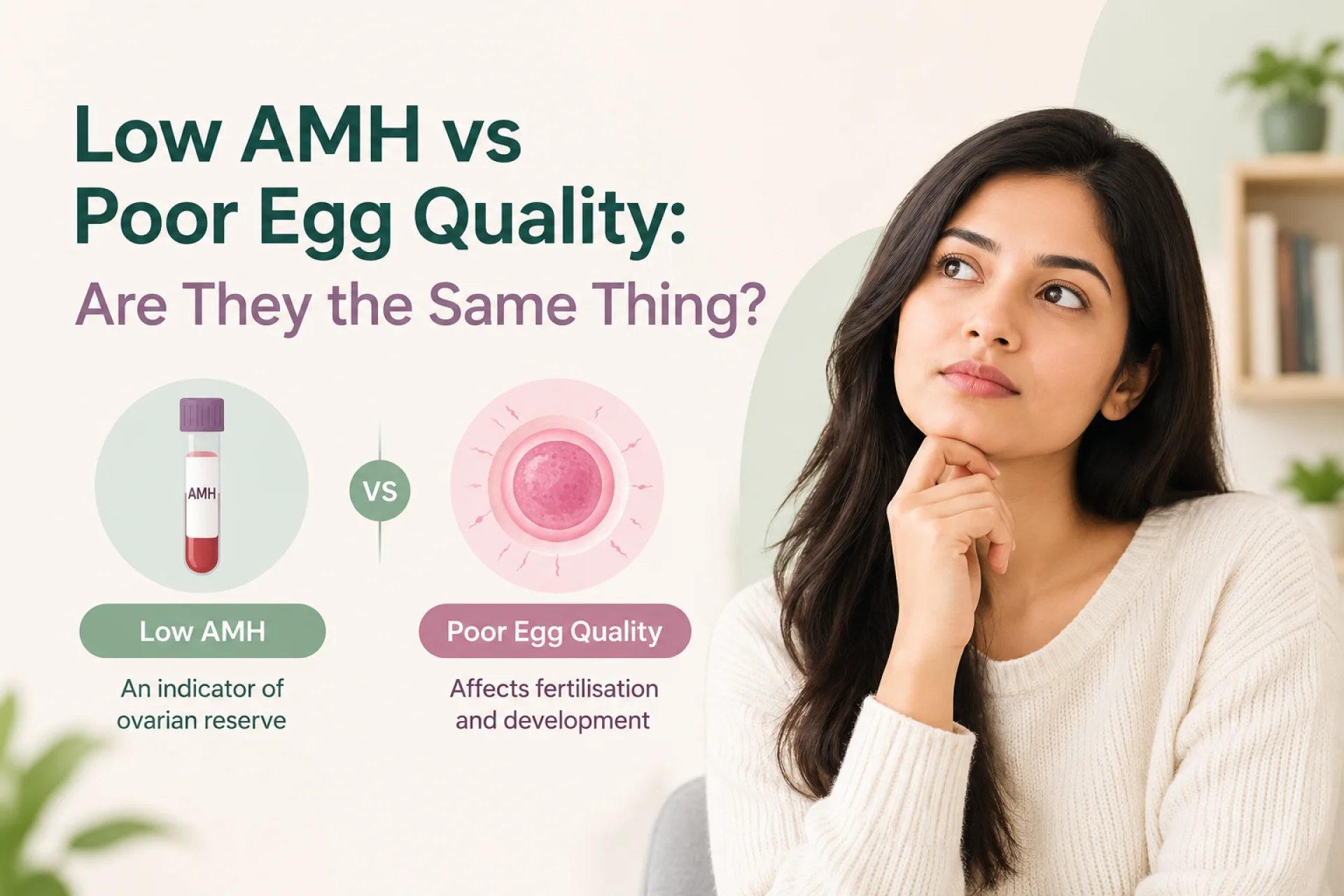
Understanding the difference between ovarian reserve (अंडों का संग्रह), egg quality (अंडों की गुणवत्ता), and the role of Ayurveda in fertility care.
A low AMH report can leave a woman with more questions than answers.
Does it mean her eggs are poor in quality?
Will she be able to conceive naturally?
Can diet, lifestyle changes, or Ayurvedic treatment improve her fertility?
These are common concerns among women who are planning a pregnancy, undergoing fertility investigations, or exploring options after unsuccessful IVF cycles.
The first thing to understand is that low AMH and poor egg quality are two different things. They can be related, particularly as a woman gets older, but one does not automatically mean the other.
At Gynocci, our approach to reproductive wellness is diagnosis-led Ayurvedic care. Understanding the difference between egg quantity and egg quality is an important starting point for informed fertility decisions. Ayurveda may offer supportive approaches to overall reproductive health, but its role must be understood alongside current medical evidence.
What is AMH, and what does a low result mean?
AMH stands for Anti-Müllerian Hormone (एंटी-मुल्लेरियन हार्मोन). It is produced by cells surrounding developing ovarian follicles (अंडाशय में विकसित हो रही छोटी थैलियाँ जिनमें अंडे होते हैं).
AMH is commonly used to estimate ovarian reserve (अंडाशय में बचे अंडों की अनुमानित संख्या). In simple terms, it helps doctors understand the approximate number of eggs that may be available and how the ovaries might respond to fertility medicines.
A low AMH result may indicate diminished ovarian reserve (अंडों के संग्रह में कमी). However, it does not directly tell us whether the remaining eggs are healthy, whether ovulation is occurring, or whether pregnancy is possible.
According to the American Society for Reproductive Medicine (ASRM), AMH is useful for estimating the number of eggs likely to be obtained during IVF stimulation, but it is a weak independent predictor of pregnancy or live birth.
So, in short, AMH estimates quantity, not quality.
What is egg quality?
Egg quality (अंडों की गुणवत्ता) refers to an egg’s ability to mature, be fertilised by sperm, support early embryo development, and ultimately contribute to a healthy pregnancy and live birth.
One important factor is the egg’s chromosome arrangement (गुणसूत्रों की सही व्यवस्था). An egg with an abnormal number of chromosomes may result in an embryo that does not develop normally or may increase the risk of miscarriage.
Egg quality is influenced strongly by age. As women grow older, the proportion of eggs with chromosome abnormalities generally increases. Other health and reproductive factors may also affect fertility, but there is no single routine blood test that directly measures the quality of every egg.
This is why a woman’s fertility assessment needs to consider more than one hormone report.
Low AMH vs poor egg quality: the key differences
| Factor | Low AMH | Poor Egg Quality |
| What it refers to | Lower estimated ovarian reserve | Reduced potential for normal fertilization and embryo development |
| How it is assessed | AMH blood test, often alongside ultrasound | Inferred from factors such as age and, in some cases, egg, embryo or genetic findings |
| Relationship with age | AMH often declines with age | Egg quality also generally declines with age |
| Does it mean pregnancy is impossible? | No | No, although the underlying cause can affect the chances |
| Can one test confirm both? | No | No single routine blood test directly confirms the quality of all eggs |
A woman may have low AMH but still have eggs capable of fertilisation and healthy embryo development. Another woman may have an AMH result within the laboratory's reference range but experience age-related egg-quality problems.
So, Low AMH and poor egg quality can occur together, but they are not interchangeable diagnoses.
Why can AMH be low?
AMH levels vary between individuals, and the result should be interpreted in relation to age, medical history, and the laboratory's reference range.
Some factors associated with lower AMH include:
- Increasing age: The number of remaining ovarian follicles generally declines over time.
- Ovarian surgery: Certain procedures may affect ovarian reserve.
- Chemotherapy or other gonadotoxic treatments: These can damage ovarian follicles.
- Premature ovarian insufficiency (समय से पहले अंडाशय की कार्यक्षमता कम होना): This may affect ovarian hormone production and reproductive function.
- Individual variation: Women of the same age can have substantially different ovarian reserve levels.
Hormonal contraceptive use may also lower measured AMH in some women, so the result may need to be interpreted in that context. A low result alone does not establish the cause.
Can low AMH be improved naturally?
This is one of the most frequently asked questions in fertility care.
The honest answer is that there is currently no established natural remedy or Ayurvedic treatment proven to replenish the ovarian egg reserve or reliably reverse age-related egg-quality decline.
Healthy lifestyle habits can support general health and reproductive well-being, but they should not be presented as a way to create new eggs or guarantee improved fertility.
It is also important to distinguish between three different outcomes:
- Improving general health: Better nutrition, sleep, and metabolic health can support overall well-being.
- Changing a laboratory result: AMH may vary between tests or over time. A change in the number does not necessarily mean that the ovarian reserve has been restored.
- Improving the chance of pregnancy: This depends on several factors, including age, ovulation, sperm health, fallopian tube function, and the circumstances of any fertility treatment.
These outcomes are related, but they are not the same.
The Ayurvedic perspective on egg health and fertility
Ayurveda approaches reproductive wellness through the wider health of the individual. It considers digestion, nutrition, tissue nourishment, daily routines, stress, and reproductive function as interconnected aspects of health.
This perspective can provide a framework for discussing lifestyle and supportive care. However, classical Ayurvedic concepts should not be treated as direct equivalents of AMH, ovarian reserve, or chromosome quality.
Understanding Artava, Shukra and Agni
Artava (आर्तव): In Ayurvedic literature, Artava is associated with female reproductive function and, depending on the context, menstrual or reproductive tissue. It is a traditional concept, not a direct measurement of egg quality or ovarian reserve.
Agni (अग्नि): Agni refers to the processes of digestion and transformation in Ayurveda. Ayurvedic practitioners may assess appetite, digestion, and food habits when planning supportive care. Agni cannot be used to determine whether an egg has normal chromosomes.
Dhatu nourishment (धातु पोषण): Ayurveda describes the nourishment of body tissues as part of maintaining health. In reproductive care, this may inform discussions about adequate nutrition, rest, and individual constitution, but it does not establish that an Ayurvedic regimen can increase egg count.
What does Ayurveda aim to support?
Depending on the individual's health and assessment, an Ayurvedic practitioner may consider:
- Balanced, nourishing dietary habits.
- Regular sleep and daily routines.
- Stress management and emotional well-being.
- Individualized herbal medicines or therapies, where appropriate.
- Monitoring symptoms and reviewing the care plan over time.
These measures may support general health and quality of life. Their ability to improve fertility outcomes specifically in women with low AMH remains uncertain.
A Sanskrit shloka on holistic health
समदोषः समाग्निश्च समधातुमलक्रियः।
प्रसन्नात्मेन्द्रियमनाः स्वस्थ इत्यभिधीयते॥
Commonly attributed to Sushruta Samhita, Sutrasthana 15.41.
Meaning in Hindi: जिसके दोष, अग्नि, धातु और मल की क्रियाएँ संतुलित हों तथा आत्मा, इन्द्रियाँ और मन प्रसन्न हों, उसे स्वस्थ कहा जाता है।
Meaning in English: Health encompasses balance in the body's functions, proper nourishment and elimination, and well-being of the mind and senses.
This verse reflects Ayurveda's broad understanding of health. It does not specifically claim that balanced doshas increase AMH or reverse poor egg quality.
What does the research say about Ayurvedic fertility treatment?
A 2024 systematic review examined 14 studies involving 248 patients, including 164 women and 84 men. The review explored Ayurvedic interventions for infertility, but much of the evidence consisted of case reports and small studies.
This is an important limitation. The available evidence does not establish that Ayurvedic treatment reliably increases AMH, restores ovarian reserve, reverses age-related egg-quality changes, or guarantees pregnancy.
Ayurvedic care may be considered as supportive care after an appropriate assessment, but it should not replace timely fertility evaluation or evidence-based treatment. Any herbal medicines should be reviewed by qualified clinicians for possible interactions with fertility drugs and other medicines.
Practical tips for women with low AMH
If your AMH report is low, the next step is to understand what it means for your individual fertility goals. Rather than chasing a higher number, focus on the decisions that can make a meaningful difference.
1. Get a complete fertility assessment
Discuss your AMH result with a gynaecologist or fertility specialist. Depending on your situation, assessment may include:
- Age, menstrual history and previous pregnancies.
- Antral follicle count (AFC), measured using ultrasound.
- FSH and estradiol (एस्ट्राडियोल) blood tests, where indicated.
- Ovulation, uterine and fallopian tube assessment, as appropriate.
- Semen analysis (वीर्य की जाँच) for your partner.
Not every person requires every test. Your clinician can decide what is appropriate.
2. Prioritise nutrition over fertility supplements
Eat a balanced diet containing vegetables, fruits, whole grains, pulses, nuts, healthy fats and adequate protein. Correct any identified nutritional deficiencies with medical guidance.
No particular food, juice, seed or supplement has been proven to restore the ovarian egg reserve.
3. Maintain a consistent sleep routine
Aim for regular, sufficient sleep and a routine that supports your physical and emotional well-being. Sleep is important for general health, although it has not been established that improving sleep raises AMH or reverses egg-quality decline.
4. Avoid smoking and excessive alcohol
Smoking is associated with adverse reproductive outcomes. Avoid tobacco, and discuss alcohol avoidance with your clinician when trying to conceive. These steps support reproductive health but cannot guarantee improved egg quality.
5. Manage stress without blaming yourself
Fertility investigations and treatment can be emotionally demanding. Yoga, gentle physical activity, breathing exercises, counselling or meditation may help manage stress.
Remember that stress is not proof of the cause of infertility. You should not be made to feel that anxiety or insufficient positivity is responsible for a low AMH result.
6. Do not delay specialist advice while trying remedies
Age and the overall clinical picture matter. Women over 35 are generally advised to seek fertility evaluation after six months of trying to conceive, while women over 40 may benefit from immediate evaluation. Earlier assessment is appropriate when there are known fertility concerns, including diminished ovarian reserve.
If you wish to explore Ayurveda, consider it alongside a timely medical assessment rather than waiting months for a particular AMH value to improve.
What should you do if AMH is low but you want a baby?
The right plan depends on your age, how long you have been trying, your medical history, and your partner's fertility assessment.
A practical approach is:
- Understand the report. Ask your doctor what your AMH result means in your particular case.
- Assess the complete picture. AMH alone cannot determine whether you can conceive naturally.
- Discuss your timeline. Your age and reproductive goals help determine whether to continue trying naturally or consider fertility treatment.
- Explore supportive care carefully. Diet, sleep, stress management, and suitable Ayurvedic care may form part of your broader health plan, but their limitations should be clear.
- Review progress with your clinician. Avoid relying on repeated AMH tests alone to judge whether treatment is working.
A low AMH report deserves attention, but it should not be interpreted as a final verdict on parenthood.
Frequently Asked Questions
1. Does low AMH mean poor egg quality?
No. Low AMH generally indicates a lower estimated ovarian reserve. Egg quality relates to the egg's potential to fertilise and support embryo development. The two can be associated, especially with increasing age, but they are not the same.
2. Can a woman with low AMH conceive naturally?
Yes, natural conception can still occur in women with low AMH. However, the likelihood depends on age, ovulation, sperm health, fallopian tube function, and other factors. AMH alone cannot provide a reliable individual prediction.
3. Can Ayurveda increase AMH levels?
There is currently insufficient high-quality evidence to conclude that Ayurvedic treatments reliably increase AMH or restore ovarian reserve. A change in AMH does not necessarily mean that egg count or egg quality has improved. Ayurvedic care should be individualised and should not delay fertility evaluation.
4. Which foods improve egg quality?
No specific food has been proven to reverse age-related egg-quality decline. A balanced diet, adequate protein, correction of nutritional deficiencies, and avoidance of tobacco support general health and reproductive well-being. Supplements should be chosen with medical advice.
5. Should I consider IVF if my AMH is low?
Low AMH alone does not mean IVF is necessary, nor does it automatically rule out IVF. It can help predict how the ovaries may respond to stimulation. A fertility specialist can discuss the likely benefits, limitations, and alternatives based on your complete assessment.
Final thoughts
Low AMH and poor egg quality are connected to different aspects of reproductive health. Understanding the distinction helps women make informed decisions without unnecessary fear or unrealistic expectations.
Ayurveda offers a traditional framework for considering nutrition, daily routines, digestion, and overall well-being. However, its role in improving egg quality or reversing diminished ovarian reserve has not been established conclusively by current clinical evidence.
The most useful next step is to understand your individual diagnosis, consider your reproductive timeline, and choose care that is appropriate for your circumstances.
At Gynocci, our approach is centred on diagnosis-led Ayurvedic care for male and female reproductive wellness and fertility, with an emphasis on individual assessment and informed treatment decisions.
Medical note: This article is for educational purposes only and is not a substitute for individual medical advice, fertility assessment, or treatment.